
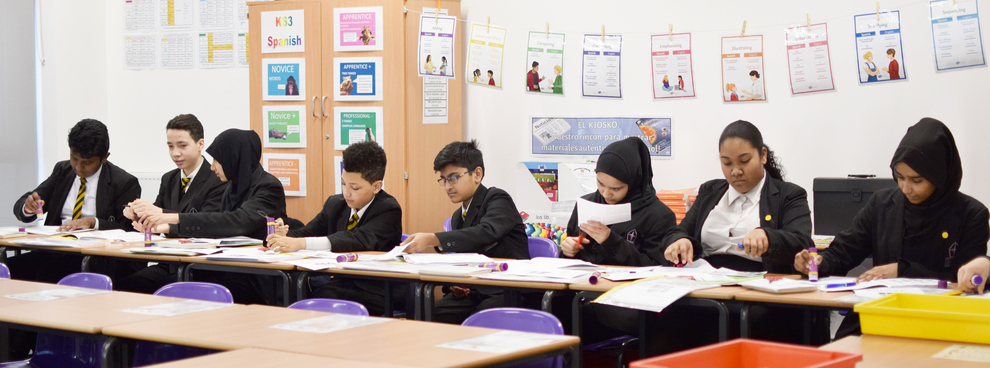
Spanish
At TALA our Languages Department aspires to ignite a lifelong passion for language learning and intercultural understanding in every student. We believe that learning a new language is not just an academic pursuit, but a gateway to global citizenship, empathy, and opportunity.
Our vision is for pupils to develop confidence, curiosity, and competence in modern foreign languages. Through high quality, engaging teaching, enrichment experiences, and real-world connections, we aim to empower all learners to:
- Communicate meaningfully and confidently in French/Spanish.
- Appreciate and respect diverse cultures, perspectives, and global communities.
- Develop transferable skills in problem-solving, memory, creativity, and resilience.
- See language learning as a key to unlocking future academic, professional, and personal growth.
We follow the Pearson prescribed curriculum at KS3 and KS4 which is underpinned by interleaving and retrieval practice so that our linguists are able to revisit and build upon existing knowledge. Lessons are structured to incorporate all skills required of the modern linguist in terms of Listening, Speaking, Reading (comprehension and aloud), Writing and Translating. Vocabulary and grammatical structures that are introduced at KS3 are seen as building blocks for more in-depth learning at KS4 (and as a solid foundation for further study at KS5). Content includes engaging and relevant topic areas including the use of authentic resources and a strong focus on building pupil’s cultural capital of Hispanic countries.
Overview
| Year | Term | Topic(s) |
| Year 7 | Autumn |
Introduction to Spanish sounds and grammar Basic vocabulary (alphabet, numbers, colours, days of the week, months, etc.) Talking about myself, friends and family Expressing opinions with justifications Talking about plans for the near future |
| Spring |
Life at school: opinions about subjects, teachers, rules, uniform Telling the time Where I live; types of house; rooms in the house Places in town; what there’s to do; what you’d like to see |
|
| Summer |
Hispanic countries and pre-Columbian civilizations Famous artists (Frida Kahlo, Picasso, Dali, Miró) End of year exams Customs and festivals Spelling /translation bee |
|
| Year 8 | Autumn |
Talking about holidays Planning a holiday Talking about mobile technology Music and films Movie unit |
| Spring |
Describing and shopping for food Ordering food in a restaurant Describing and shopping for clothes Going about town Daily routines |
|
| Summer |
Describing what you can do in town Asking for directions End of year exams Topical module Research project |
|
| Year 9 | Autumn |
Free time activities and hobbies Confident use of three tenses Jobs and occupations Consider plans for the future |
| Spring |
Healthy lifestyles and healthy eating Daily routine and parts of the body and illnesses Children’s rights; understand the concept of fair trade Explore ways to protect the environment, ie recycling |
|
| Summer |
Meeting and greeting Visiting places of interest and shopping End of Year exams Movie Unit |
|
| Year 10 | Autumn |
Talking about life online Sports and leisure activities Saying what you did on the weekend incl days that went wrong Describing what you did/where you stayed on holiday Festivals in Hispanic countries |
| Spring |
Family, friends and personal identity Relationships and who you admire Giving advice Mealtimes and food trends Healthy lifestyles and future plans for improving health and well-being Illnesses and injuries |
|
| Summer |
School: typical day, opinions on your studies, teachers and other pupils, what you would change Describing cities and how they have changed Shopping preferences Your local area Describing a recent school trip End of year exams |
|
| Year 11 | Autumn |
How you help in the community Climate change and environmental action Plans for the future and career intentions Getting a job Mock examinations |
| Spring |
The importance of learning a language Changes in the world of work Mock examinations and feedback Preparation for the mock Speaking exam Speaking mock feedback Revision and exam practice |
|
| Summer |
Mock feedback Preparation and recording of the Speaking exam GCSE examinations |
Qualification Details
| Exam Board | AQA |
| Course Title and Syllabus |
GCSE Spanish has a Foundation Tier (grades 1–5) and a Higher Tier (grades 4–9). Students study all of the following themes on which the assessments are based:
|
Details of Papers |
Listening – 25% of GCSE
Speaking – 25% of GCSE
Reading – 25% of GCSE
Writing – 25% of GCSE
|